Client problem
A projection technology client required a precision sensing system to assist with the alignment and calibration of large-scale multi-projector video installations used for architectural projection mapping and complex 3D projection surfaces.
Traditional projector alignment methods were extremely time-consuming and difficult when working across:
- Large buildings and structures
- Multiple overlapping projectors
- Complex 3D projection surfaces
- High-brightness installations requiring pixel-perfect alignment
The client had developed a novel concept using fibre optic sensing points positioned across the projection surface to detect projected calibration patterns and automate projector alignment processes.
The system needed to:
- Detect projected light patterns with high precision
- Support real-time frame-based light analysis
- Operate reliably with multiple projector technologies
- Support large distributed sensing installations
- Integrate with external calibration software using Ethernet APIs
- Allow scalable multi-channel deployment
- Provide rapid installation and setup within live event environments
Solution
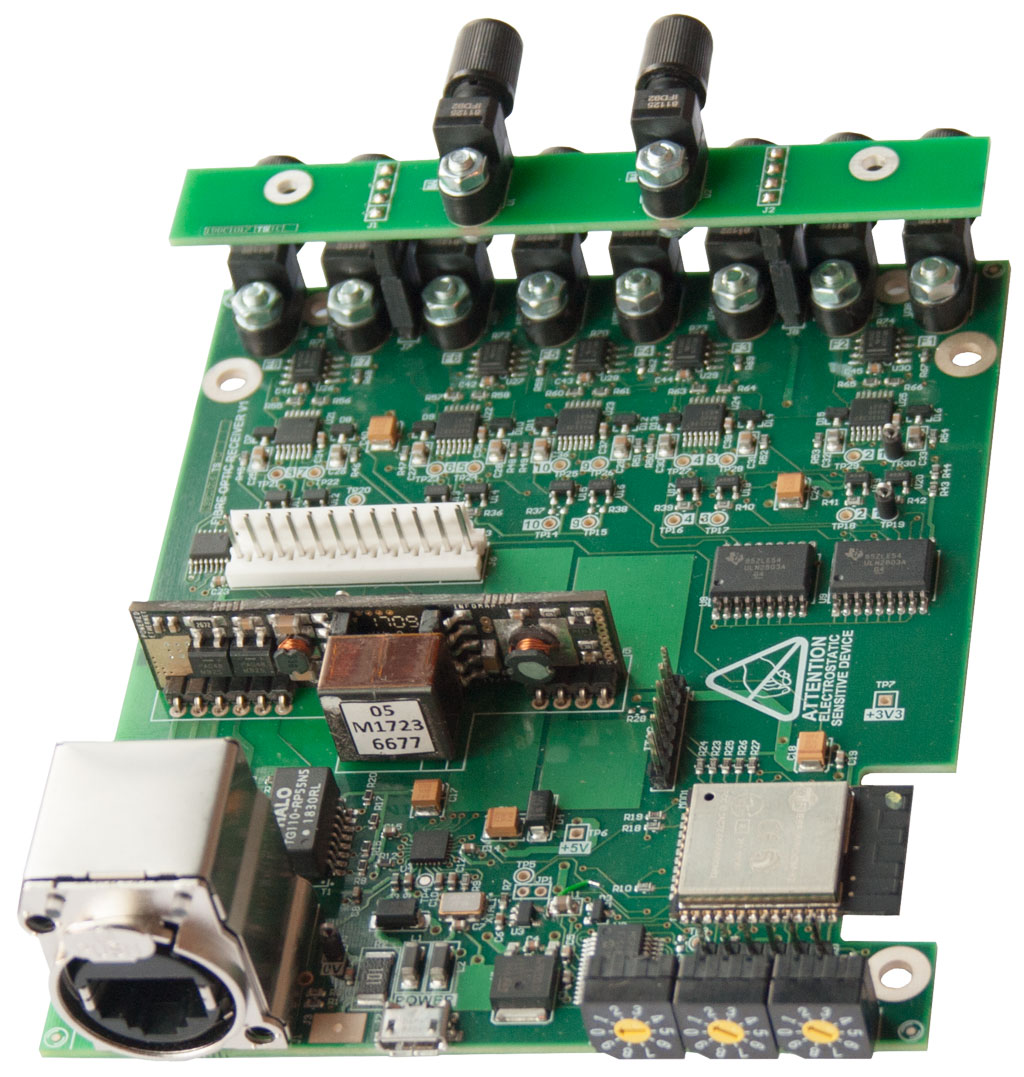
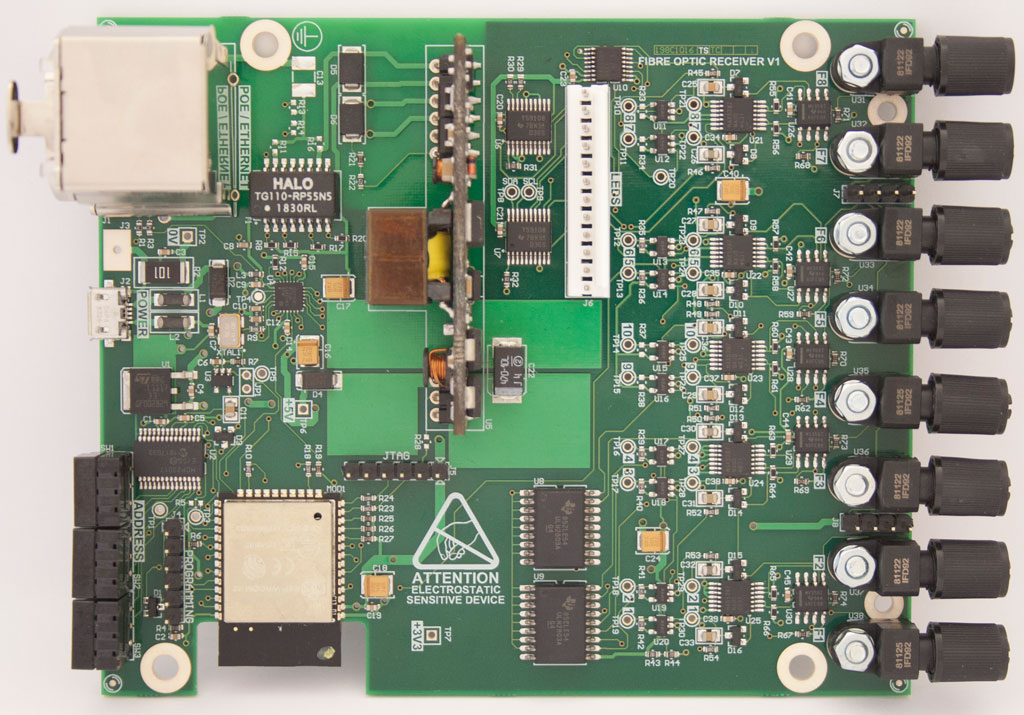
Designed and developed a custom fibre optic light detection platform incorporating precision analogue sensing electronics, embedded firmware and Ethernet-based communications infrastructure.
The system incorporated:
- Fibre optic photodiode detection hardware
- Real-time light level sensing
- Automatic calibration of individual sensing channels
- Fast frame-by-frame light capture
- Peak light detection for high-speed projector systems
- Ethernet communications with TCP/IP API integration
- PoE-powered deployment
- Multi-channel expansion architecture
- Individually addressable visual identification LEDs
- Embedded control using ESP32 architecture
The platform enabled rapid automated detection of projected calibration patterns across large surfaces, significantly reducing the complexity and time required for multi-projector alignment and calibration.
A modular architecture was also developed allowing multiple fibre optic sensing nodes to be deployed throughout large installations while maintaining simple network integration and centralised software control.
IBEX Role
- Full electronics hardware design
- Precision analogue sensing circuit development
- Embedded firmware development
- PCB schematic and layout design
- Ethernet and PoE integration
- TCP/IP protocol design
- ESP32 embedded platform development
- Sensor calibration system development
- Real-time signal processing implementation
- API and communications architecture
- Prototype development
- Technical documentation and source code delivery
Technology Stack
- ESP32
- Embedded C/C++
- TCP/IP networking
- Ethernet / PoE
- Fibre optic sensing systems
- Precision analogue electronics
- Photodiode signal processing
- Real-time frame capture systems
- Embedded calibration systems
Challenges Overcome
- Detecting rapidly changing projected light patterns at 60 frames per second
- Supporting projector technologies with fast-scanning and time-multiplexed RGB output
- Designing highly sensitive analogue detection circuitry with software-controlled calibration
- Implementing peak-detection filtering for accurate frame capture under varying projector technologies
- Managing large differences in brightness levels caused by projector type, distance and ambient lighting conditions
- Designing scalable multi-channel sensing hardware with low installation complexity
- Providing reliable real-time Ethernet communications for synchronised calibration workflows
- Delivering a modular and field-serviceable system suitable for live deployment environments
Outcome
Successfully delivered a complete fibre optic projection alignment platform including custom sensing hardware, embedded firmware and Ethernet-based communications systems.
The resulting system enabled rapid automated calibration and alignment of complex multi-projector installations while providing the client with full source code ownership for future in-house development and expansion.